

Box2D Prismatic Joint
Description
This example creates a Box2D prismatic joint at runtime. The blue dynamic body (slider) is constrained to a diagonal rail, moves between two translation limits, and reverses its motor when it reaches either end.
Click or tap the window to reverse the motor manually.
There are no differences in scripting between Box2D V2 and V3 in this example.
What You’ll Learn
- How to get Box2D body handles from Defold collision objects
- How to create a prismatic joint with
b2d.joint.create_prismatic() - How
local_axis_a,lower_translation, andupper_translationdefine the slide rail - How to control a prismatic joint motor with
b2d.joint.set_motor_speed()
Setup
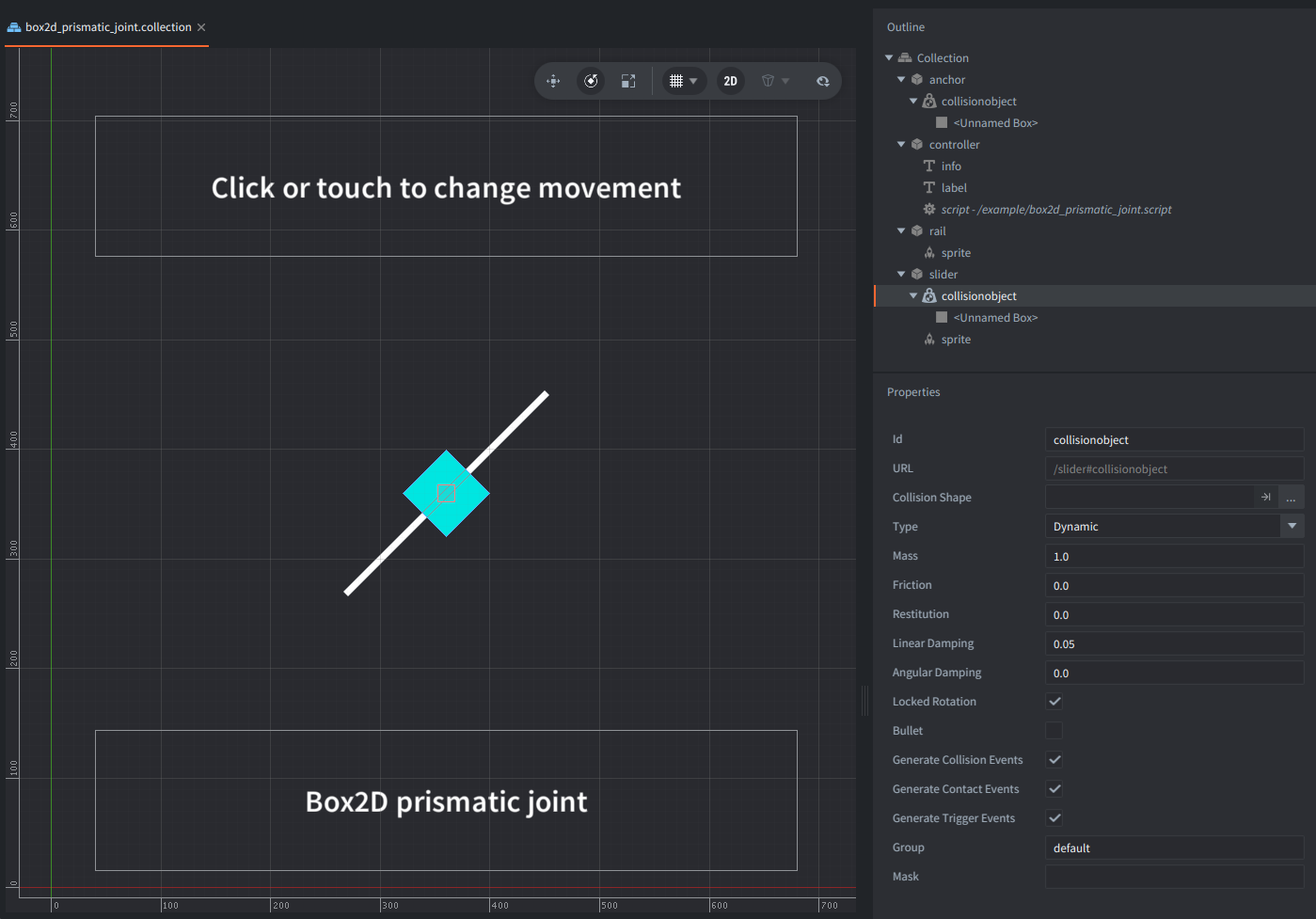
The collection contains:
controllergame object with the main script and labels with informationsrailgame object with static collision object for frame reference for the prismatic joint and a sprite rotated by 45 degrees around Z axis to indicate the “rail”slidergame object with a dynamic collision object and a sprite to indicate where the slider is
The rail and slider bodies start at the same world position in the middle.
The game.project of this example is configured to build with /box2d_v3.appmanifest by default.
To test V2 locally after downloading the example, change Native Extensions -> App Manifest in game.project to /box2d_v2.appmanifest.
How It Works
The script uses b2d.get_body() to fetch the Box2D bodies owned by the rail and slider collision objects.
Then calls b2d.joint.create_prismatic() which creates the prismatic joint between them,
with local_axis_a set to the same diagonal direction as the visible rail (rotated 45 degrees areound Z axis),
enables limits from -110 to 110 project units, and a motor, sets a maximum motor force, and starts the slider moving along the rail.
The prismatic joint is a constraint solver - only defines how two bodies are allowed to move, not why they should move. So normally, the slider would fall in the gravity direction, but would be moving constrained like a slider along a rail. We enable the motor in the example to move in both direction along the rail. Motor applied on a prismatic joint moves the object along the joint axis at the given linear speed.
During update(), the script reads b2d.joint.get_joint_translation(), which returns the position alongside the constraint,
and reverses the motor when the translation reaches either limit.
On input (touch or mouse click) the direction of the motor that applies force to the slider changes too.
Scripts
box2d_prismatic_joint.script
-- Unit vector for a 45 degree rail. This is the same direction as the rail sprite.
local AXIS = vmath.vector3(0.70710678, 0.70710678, 0)

-- Prismatic translation is measured along `local_axis_a`, in project units.
-- Define farthest limits on both ends:
local LOWER_TRANSLATION = -110
local UPPER_TRANSLATION = 110

-- Define motor speed that will be used to move the slider
local MOTOR_SPEED = 50

-- Some maximum motor force allows to apply a force on the slider to push it
local MAX_MOTOR_FORCE = 1200

function init(self)
    -- This will be storing a current direction of the slider
    self.direction = 1

    -- Acquire input focus to handle inputs
    msg.post(".", "acquire_input_focus")

    -- `b2d.get_body()` returns the native Box2D body created by the given collision object.
    local slider = b2d.get_body("/slider#collisionobject")
    local anchor = b2d.get_body("/rail#collisionobject")

    -- This creates a prismatic joint in runtime between the 2 bodies - an anchor and a slider.
    -- The joint axis matches the visible diagonal rail in the collection.
    self.joint = b2d.joint.create_prismatic(anchor, slider, {
        -- Both bodies start at the same position, so zero local anchors share the same joint origin.
        local_anchor_a = vmath.vector3(),
        local_anchor_b = vmath.vector3(),

        -- The axis is local to body A, the static anchor.
        local_axis_a = AXIS,

        -- Limits keep the dynamic body between the two ends of the rail.
        enable_limit = true,
        lower_translation = LOWER_TRANSLATION,
        upper_translation = UPPER_TRANSLATION,

        -- The motor pushes the slider along the axis without extra forces in update().
        enable_motor = true,
        max_motor_force = MAX_MOTOR_FORCE,
        motor_speed = self.direction * MOTOR_SPEED,

        -- The connected bodies do not need to collide with each other in this example.
        collide_connected = false,
    })
end

-- Helper function to reverse the motor direction
local function reverse_motor(self)
    -- Assign a negative direction to the current direction variable
    self.direction = -self.direction

    -- Positive and negative speed move the slider in opposite directions along the axis.
    b2d.joint.set_motor_speed(self.joint, self.direction * MOTOR_SPEED)
end

function update(self, dt)
    -- The function returns a translation on the defined joint in project units
    local translation = b2d.joint.get_joint_translation(self.joint)

    -- Reverse automatically when the slider reaches either translation limit.
    if self.direction > 0 and translation > UPPER_TRANSLATION then
        reverse_motor(self)
    elseif self.direction < 0 and translation < LOWER_TRANSLATION then
        reverse_motor(self)
    end

    -- Create a string describing the current direction
    local direction_string = self.direction > 0 and "up-right" or "down-left"

    -- Update the information on the label
    label.set_text("#label", string.format("Motor: %s\nTranslation: %.0f", direction_string, translation))
end

function on_input(self, action_id, action)
    -- The built-in touch action also covers mouse clicks in the built-in all.input_binding.
    if action_id == hash("touch") and action.pressed then
        -- When click or touch is pressed we reverse the motor direction
        reverse_motor(self)
    end
end

function final(self)
    -- Joints created through b2d.joint should be explicitly destroyed.
    if self.joint then
        b2d.joint.destroy(self.joint)
        self.joint = nil
    end

    -- Release input focus
    msg.post(".", "release_input_focus")
end