

Box2D Sensors
Description
This example shows how to utilize the Box2D scripting API to operate with sensors (triggers). It spawns dynamic physics balls from slightly different random positions near the top of the scene, and gravity pulls each ball down, and these pass through two collision objects.
What You’ll Learn
- How to get a Box2D body from a collision object with
b2d.get_body(). - How to turn a Box2D V2 fixture into a sensor with
b2d.fixture.set_sensor(). - How to recreate a Box2D V3 shape as a sensor with
b2d.body.create_shape(). - How to count V2 sensor overlaps from
trigger_responseenter/exit messages. - How to poll V3 sensor overlaps with
b2d.shape.get_sensor_overlaps().
Setup
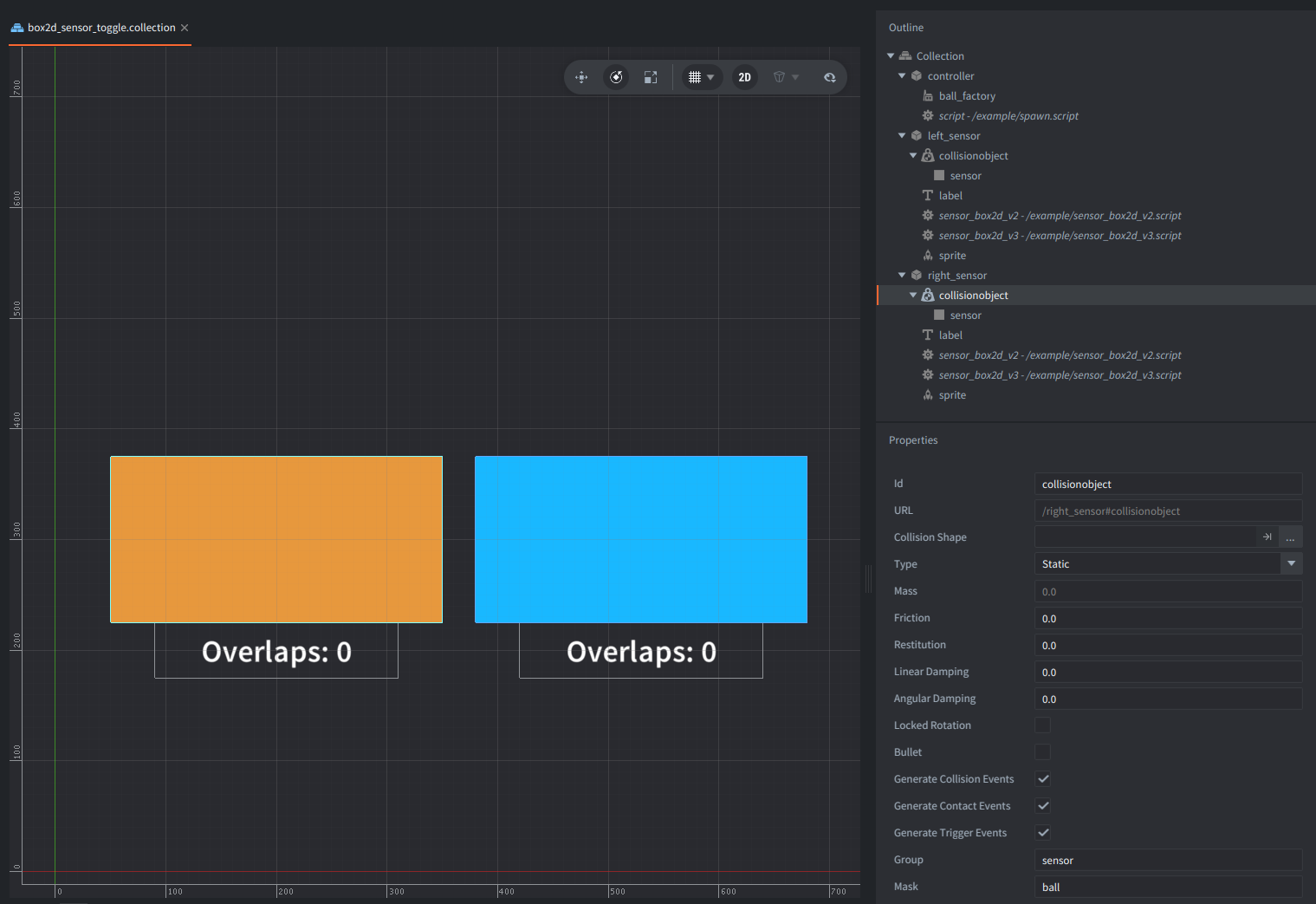
The collection contains one controller game object with spawn.script and a ball_factory.
The factory creates ball.go - a small prototype with one sprite and one dynamic circle collision object.
The two sensor game objects both contain:
sensor_box2d_v3.script- for Box2D V3 example handlingsensor_box2d_v2.script- for Box2D V2 example handling- A sprite, label, and static collision object with component id
collisionobject.
The collision objects are of type Static in the editor.
All sensors use the sensor collision group and mask the ball group.
The spawned ball belongs to the ball collision group and masks the sensor group,
so the sensor overlaps only include spawned balls.
The game.project currently uses /box2d_v3.appmanifest.
To test V2 locally, change Native Extensions -> App Manifest to /box2d_v2.appmanifest.
Gravity set in game.project causes the falling motion.
How It Works
The controller spawns a ball repeateadly with factory.create().
Each ball is spawned at a random X position near the center, and is deleted after a short delay.
The spawned balls pass through the sensor’s collision object shapes.
Each sensor has two backend scripts (V2 and V3), but only one runs processing depending on a choosen Box2D version.
Each script checks b2d.get_version().major in init() and returns immediately when the active backend does not match.
At startup, the active Box2D script changes the static collision geometry into a sensor (trigger) through the b2d API.
Box2D V2 and V3 expose this through different scripting APIs:
- V2 uses fixtures and Defold trigger messages.
- V3 uses shapes and can poll a sensor shape’s current overlaps directly.
In Box2D V2, sensor_box2d_v2.script gets the body with b2d.get_body("#collisionobject"),
reads the first fixture with b2d.body.get_fixtures(), and calls b2d.fixture.set_sensor(),
so the fixture no longer blocks the balls. V2 fixture sensors do not expose a get_sensor_overlaps() polling API.
But Defold still sends trigger_response messages when another collision object enters or exits the sensor,
and the script maintains a Lua table of current overlapping ball ids.
In Box2D V3, sensor_box2d_v3.script uses the shape API.
It reads the first editor-authored shape with b2d.body.get_shapes() and b2d.shape.get_shape(),
destroys that solid shape, and creates a replacement with b2d.body.create_shape() using the same geometry and sensor = true.
The V3 script then calls b2d.shape.enable_sensor_events() for the new sensor shape.
In update(), it polls the current overlaps with b2d.shape.get_sensor_overlaps().
This returns shape info tables for the shapes currently overlapping the sensor.
Both scripts gives us the same result: each sensor sprite scales up while at least one ball overlaps it, and the label shows the current overlap count reported by the active backend path.
Scripts
sensor_box2d_v3.script
-- Helper function to create a sensor from the collision object for scripting
local function create_sensor_shape()
    -- `b2d.get_body()` returns the native Box2D body created by this collision object.
    local body = b2d.get_body("#collisionobject")

    -- In Box2D V3, collision geometry is attached to a body as shapes.
    -- Read the first editor-authored shape so the runtime sensor keeps the same size.
    local shape = b2d.body.get_shapes(body)[1]
    local shape_definition = b2d.shape.get_shape(body, shape.index)

    -- The editor-authored shape is solid, so it would block the falling ball.
    -- Remove it before creating the replacement sensor shape.
    b2d.body.destroy_shape(body, shape.index)

    -- A sensor shape reports overlaps without producing collision response.
    -- The ball can pass through it, but Box2D still tracks which shapes overlap it.
    local sensor = b2d.body.create_shape(body, {
        shape = shape_definition,
        friction = 0.0,
        restitution = 0.0,
        sensor = true,
    })

    -- V3 sensor overlap polling is opt-in. Without this call,
    -- `get_sensor_overlaps()` would not return the current overlap list.
    b2d.shape.enable_sensor_events(sensor.shape_id, true)
    return sensor.shape_id
end

function init(self)
    -- This script uses the Box2D V3 shape API.
    self.active = b2d.get_version().major == 3

    -- If Box2D V3 is not used, skip further processing
    if not self.active then
        return
    end

    self.sensor_shape = create_sensor_shape()
    self.overlaps = {}
end

local NORMAL_SCALE = vmath.vector3(1.0)
local LARGER_SCALE = vmath.vector3(1.1)

function update(self, dt)
    -- If Box2D V3 is not used, skip further processing
    if not self.active then
        return
    end

    -- V3 returns the shapes currently overlapping this sensor shape.
    self.overlaps = b2d.shape.get_sensor_overlaps(self.sensor_shape)

    -- Set the sprite scale to indicate the overlapping visually
    if #self.overlaps > 0 then
        go.set("#sprite", "scale", LARGER_SCALE)
    else
        go.set("#sprite", "scale", NORMAL_SCALE)
    end

    -- Update the label text to show the amount of overlaps
    label.set_text("#label", "Overlaps: " .. #self.overlaps)
end
sensor_box2d_v2.script
-- Helper function to convert a collision object to a sensor (trigger) for scripting
local function enable_sensor_fixture()
    -- `b2d.get_body()` returns the native Box2D body created by this collision object.
    local body = b2d.get_body("#collisionobject")

    -- In Box2D V2, collision geometry and material data live in fixtures.
    -- The collection-authored fixture starts solid, so the ball would collide with it.
    local fixture = b2d.body.get_fixtures(body)[1]

    -- Turning the fixture into a sensor disables physical collision response.
    -- Box2D still reports trigger-style enter/exit interactions for overlaps.
    b2d.fixture.set_sensor(body, fixture.index, true)
end

function init(self)
    -- This script uses the Box2D V2 fixture API.
    self.active = b2d.get_version().major == 2

    -- If Box2D V2 is not used, skip further processing
    if not self.active then
        return
    end

    enable_sensor_fixture()
    self.overlaps = {}
end

local NORMAL_SCALE = vmath.vector3(1.0)
local LARGER_SCALE = vmath.vector3(1.1)

function on_message(self, message_id, message, sender)
    -- If Box2D V2 is not used, skip further processing
    if not self.active then
        return
    end

    -- Defold sends `trigger_response` when a sensor fixture starts or stops
    -- overlapping another collision object allowed by the collision mask.
    if message_id == hash("trigger_response") then

        -- Store overlaps in a table or clear those that exited the sensor
        if message.enter then
            self.overlaps[message.other_id] = true
        else
            self.overlaps[message.other_id] = nil
        end

        -- Count overlaps
        local count = 0
        for i,v in pairs(self.overlaps) do count = count + 1 end

        -- Set the sprite scale to indicate the overlapping visually
        if count > 0 then
            go.set("#sprite", "scale", LARGER_SCALE)
        else
            go.set("#sprite", "scale", NORMAL_SCALE)
        end

        -- Update the label text to show the amount of overlaps
        label.set_text("#label", "Overlaps: " .. count)
    end
end
spawn.script
-- Helper function to spawn a ball at random position on top and remove it after a moment
local function spawn_ball()
    -- X position is random between 200-600
    local x = 400 + math.random(-200, 200)

    -- Spawn the ball from the ball_factory, assign the random position
    -- and store the created instance's id
    local id = factory.create("#ball_factory", vmath.vector3(x, 600, 0.0))

    -- After a moment remove the spawned ball
    timer.delay(1.2, false, function()
        go.delete(id)
    end)
end

function init(self)
    -- Initialize random number generator
    math.randomseed(os.time())

    -- Use the above helper function to spawn the ball every 0.5 second
    timer.delay(0.2, true, spawn_ball)
end